
Introduction
In today’s digital world, having a website is not enough for creating an online presence. In order to attract visitors to your website and achieve better rankings on search engines such as Google, you have to optimize your website efficiently. Among many other techniques related to SEO, On-Page SEO is considered one of the most effective ways. On-Page SEO Techniques are used for optimizing web pages in order to rank them in the search engines and also create a better user experience.
This blog post will help you understand the meaning of On-Page SEO, its importance and the techniques you need to know about as a digital marketer.
What Is On-Page SEO?
On-Page SEO is defined as the optimization of content and HTML elements of a webpage so that the search engines will be able to understand the purpose of a web page and users will be able to easily find out what they want. On-Page SEO Techniques include optimizing elements you can control on your webpage. Unlike off-page SEO which includes backlinks and other external activities, on-page SEO includes elements you can optimize.
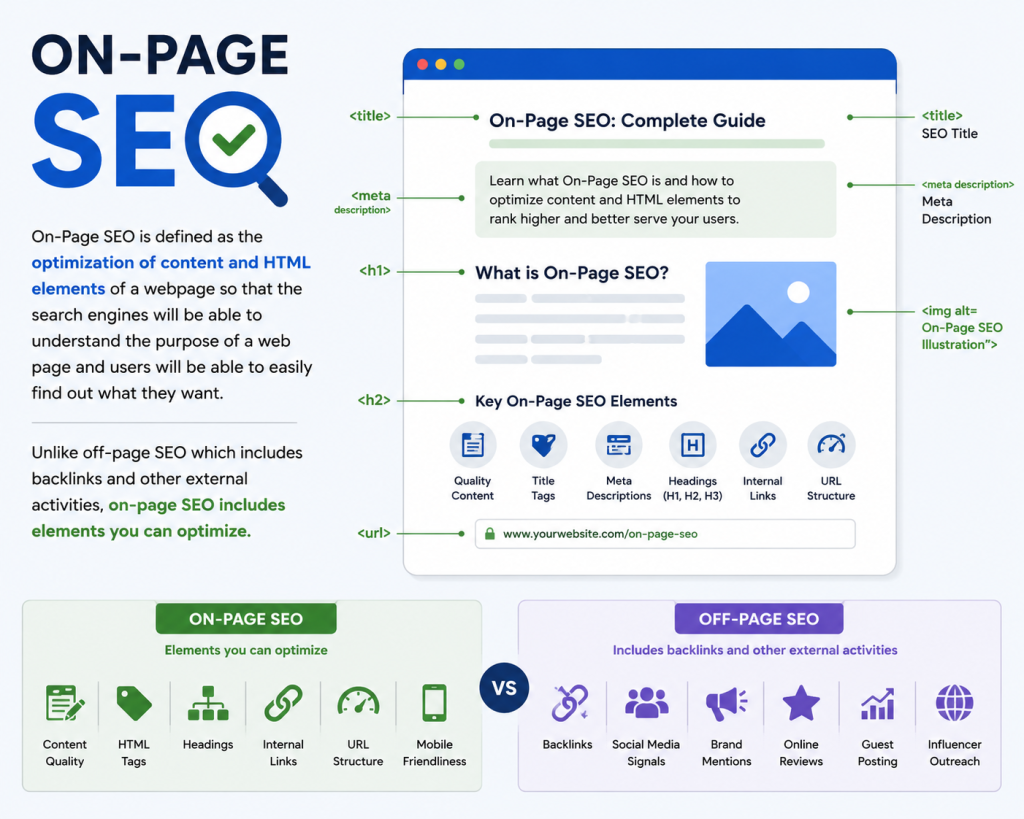
The main purpose of On-Page SEO is the improvement of organic traffic, search engine ranking, and user experience.
Why Is On-Page SEO Necessary?
There are multiple advantages of On-Page SEO, such as:
. Makes the website more visible in search results.
. Assists in comprehension of the content by search engines.
. Promotes the growth of organic website traffic.
. Improves user experience and website usability.
. Click-through rates (CTR) improvement.
. Facilitates the achievement of higher conversion rates through providing relevant content.
On-Page SEO Techniques
1. Keyword Research and Insertion
Keyword research is the initial stage of On-Page SEO. You need to know what types of keywords your potential customers use and insert them into the following parts of your website as part of On-Page SEO Techniques:
. Page titles
. Headings (H1, H2, H3)
. Opening and closing paragraphs
. URLs
. Meta descriptions
. Alt texts for images
2. Optimize Title Tags
The title tag is one of the first pieces of information shown in search results. The optimized title must:
. Contain the primary keyword.
. Be clear and catchy.
. Be around 50 – 60 characters.
Example:
On-Page SEO: Key Techniques That Will Help Your Website Rankings
3. Generate a Useful Meta Description
A meta description gives details regarding the nature of the web page. Although not used directly for the purpose of ranking, the meta description has some effect on the click-through rate.
Some tips include:
. Should be 150 -160 characters.
. Should have the main keyword.
. Should contain engaging content.
4. Use Proper Heading Structure
Using the proper heading structure will help organize your content and increase its readability.
. H1 for the title.
. H2 for major headings.
. H3 and H4 for minor headings.
5. Quality Content
One key factor in On-Page SEO is content, which should be:
. Unique
. Informative
. Well structured
. Easy to read
. User intent related
It is important to update your content periodically.
6. Optimize URLs
SEO-friendly URLs must be:
. Short
. Descriptive
. Meaningful
. Include the primary keyword
Good Example:
`www.example.com/on-page-seo-techniques`
7. Internal Links
Internal links link a page from your website with other pages of your website.
Some of the benefits of using internal linking include:
. Helps you navigate through the website.
. Spreads page authority.
. Keeps people on your website.
8. Image Optimization
Images increase the engagement level but need to be optimized too.
Steps to optimize images include:
. Descriptive filename.
. Use relevant keywords in alt tags.
. Compress the images for quick loading.
. Appropriate size of images.
9. Improve Page Loading Time
The loading speed of the website needs to be improved for good user experience and higher ranking.
Steps to improve page speed include:
. Image compression.
. Reduce CSS & JavaScript files.
. Browser caching needs to be turned on.
. Use Content Delivery Network (CDN).
10. Mobile Responsive Design
As the majority of users access the websites using smartphones; it is essential to have mobile responsive website design.
Mobile responsiveness includes:
. Website displays perfectly on all devices.
. Quick loading on mobile connections.
. Use readable font size and buttons.
11. User Experience (UX) Optimization
Search engines prefer those websites that offer good user experience.
UX optimization includes:
. Easy navigation.
. Good layout.
. Typography.
. Minimal intrusive pop-ups.
12. Add Schema Markup
Schema Markup will allow search engines to understand the content that is present on your website. Moreover, with schema markup, you can give a better appearance to your website in the Search Engine Result Pages (SERPs).
Common On-Page SEO Mistakes
Do not make such mistakes as:
• Keyword stuffing.
• Content duplication.
• No presence of title tags and meta descriptions.
• Slow loading pages.
• Broken internal links.
• Ineffective mobile optimization.
• Absence of Alt text for images.
On-Page SEO Best Practices
• Quality unique content creation.
• Updating older posts.
• Using natural keywords.
• Fastening the speed of website.
• Mobile optimization of web pages.
• Creating internal links.
• Optimization of individual pages.
• Performance analysis through analytics and SEO tools.
Conclusion
On-Page SEO is undoubtedly one of the cornerstones of digital marketing. By improving your website’s content, structure, and technicalities, you not only make the job of search engines easy but also create an experience that your users will enjoy. Using the On-Page SEO techniques such as keyword optimization, content creation, internal links, image optimization, and mobile responsiveness, you can effectively increase the visibility of your website. You can visit my website to know more about On-Page SEO.
On-Page SEO should be practiced by everyone regardless of whether they are beginners or experienced digital marketers. You can contact me on WhatsApp